
QuillBot vs Turnitin 2026: Accuracy, access, and use cases
Turnitin is the stronger choice for a formal school review. QuillBot is easier to access for checking a draft before submission. The two platforms overlap in AI and originality checks, but they do different jobs.
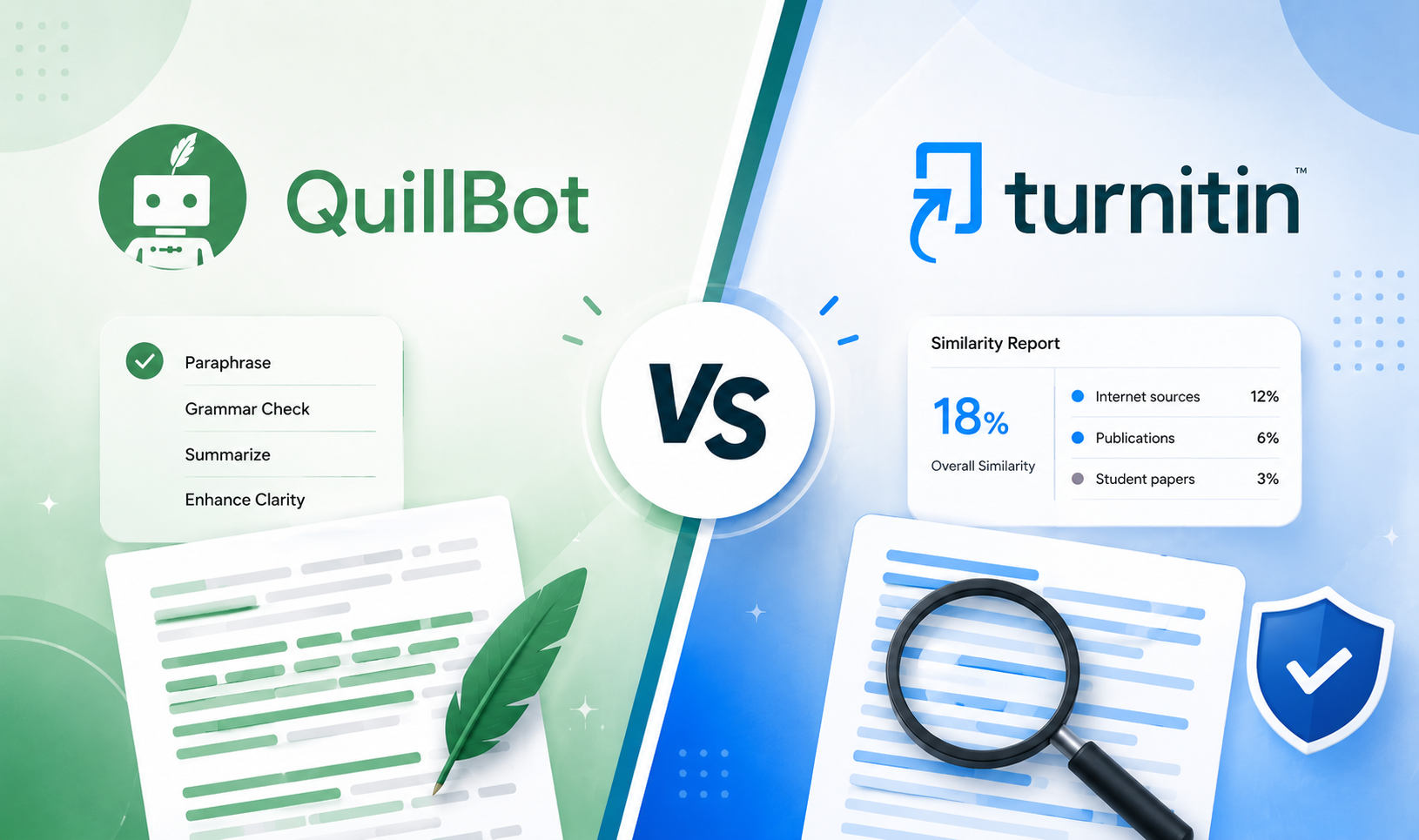
Turnitin is the stronger choice for a formal school review. QuillBot is easier to access for checking a draft before submission. The two platforms overlap in AI and originality checks, but they do different jobs.
So, we’ve done this Quillbot vs Turnitin comparison to examine their reports, pricing, access rules, and accuracy limits. We also wanted to answer the question students often ask: Can Turnitin flag writing that has passed through QuillBot?
QuillBot vs Turnitin at a glance
| Tool | Best for | Individual access | Main originality result | Main AI result |
|---|---|---|---|---|
| QuillBot | Quick draft checks and writing support | Available directly with Free and Premium plans | Plagiarism score, matched sources, and citation help with Premium | 0–100% AI likelihood score with sentence-level feedback |
| Turnitin | Institution-led review of submitted work | Access normally comes through a school or organization | Similarity percentage with matched passages and sources | AI Writing Report for qualifying submissions when the institution licenses it |
QuillBot AI detector analysis
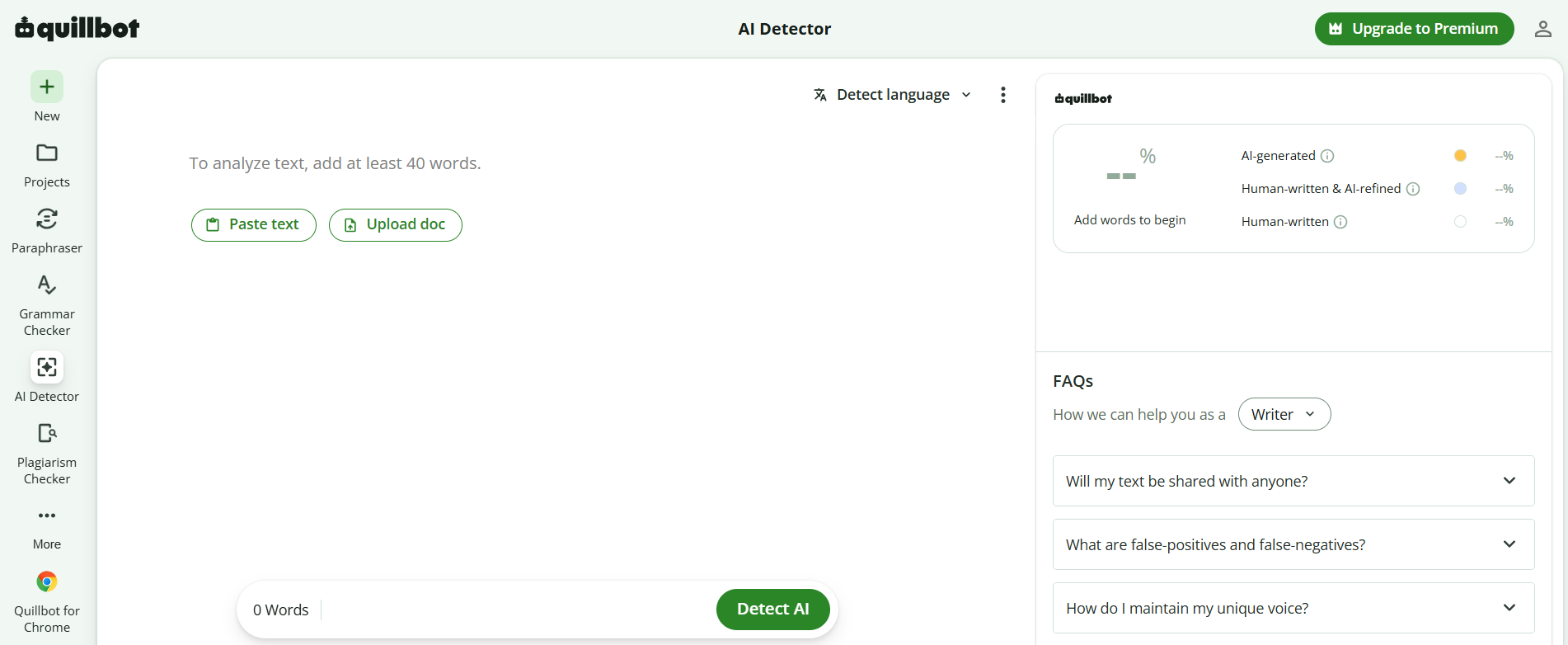
The QuillBot AI Detector estimates how likely a passage is to contain AI-generated writing. Paste at least 80 words. It returns a 0–100% score with highlights and short explanations.
QuillBot’s detector can separate AI-written text from human writing refined with AI. The result remains a probability estimate, not proof of authorship.
A QuillBot plagiarism checker vs Turnitin comparison should separate AI detection from source matching. QuillBot’s AI Detector studies writing patterns. Its separate Plagiarism Checker searches for matching language.
How the QuillBot AI detector scores text
The result combines a percentage with sentence-level highlights and explainer cards. QuillBot says it assesses predictability, repetition, and sentence variation.
A high score means the model found strong AI-like signals. It did not observe the writing process or identify a generator.
One detail can skew any QuillBot Turnitin comparison: the percentages are not equivalent. QuillBot scores the pasted passage, while Turnitin scores only qualifying prose in eligible institutional submissions.
Access, pricing, and plan limits
QuillBot offers a permanent free plan. Its live detector page lists up to 1,200 words per free scan and six scans daily. Premium removes those limits and adds full explainers and downloadable reports.
So, is Quillbot reliable as a pre-check? It can reveal passages worth rereading. Premium raises the limits, but it cannot verify authorship.
Current access and pricing
| Plan or access route | Price | AI detection | Plagiarism checking | Important detail |
|---|---|---|---|---|
| QuillBot Free | $0 | Up to 1,200 words per scan; live page lists up to 6 scans daily | Not included | Free access is ongoing, not a timed Premium trial |
| QuillBot Premium monthly | $19.95 per month | Unlimited scans and words | 25,000 words per month | Renews monthly unless canceled |
| QuillBot Premium quarterly | $39.95 every 3 months | Unlimited scans and words | 25,000 words per month | Equivalent to about $13.32 per month |
| QuillBot Premium annual | $99.95 per year | Unlimited scans and words | 25,000 words per month | Equivalent to about $8.33 per month |
| Turnitin institutional access | Custom quote | Depends on the institution’s license and settings | Included in relevant Similarity products | No individual or single-use Turnitin subscription |
Comparing QuillBot with Turnitin
QuillBot helps individuals inspect drafts. Turnitin helps schools review submissions.
Does Turnitin check for AI? Yes, if the school licenses and enables the AI Writing Report.
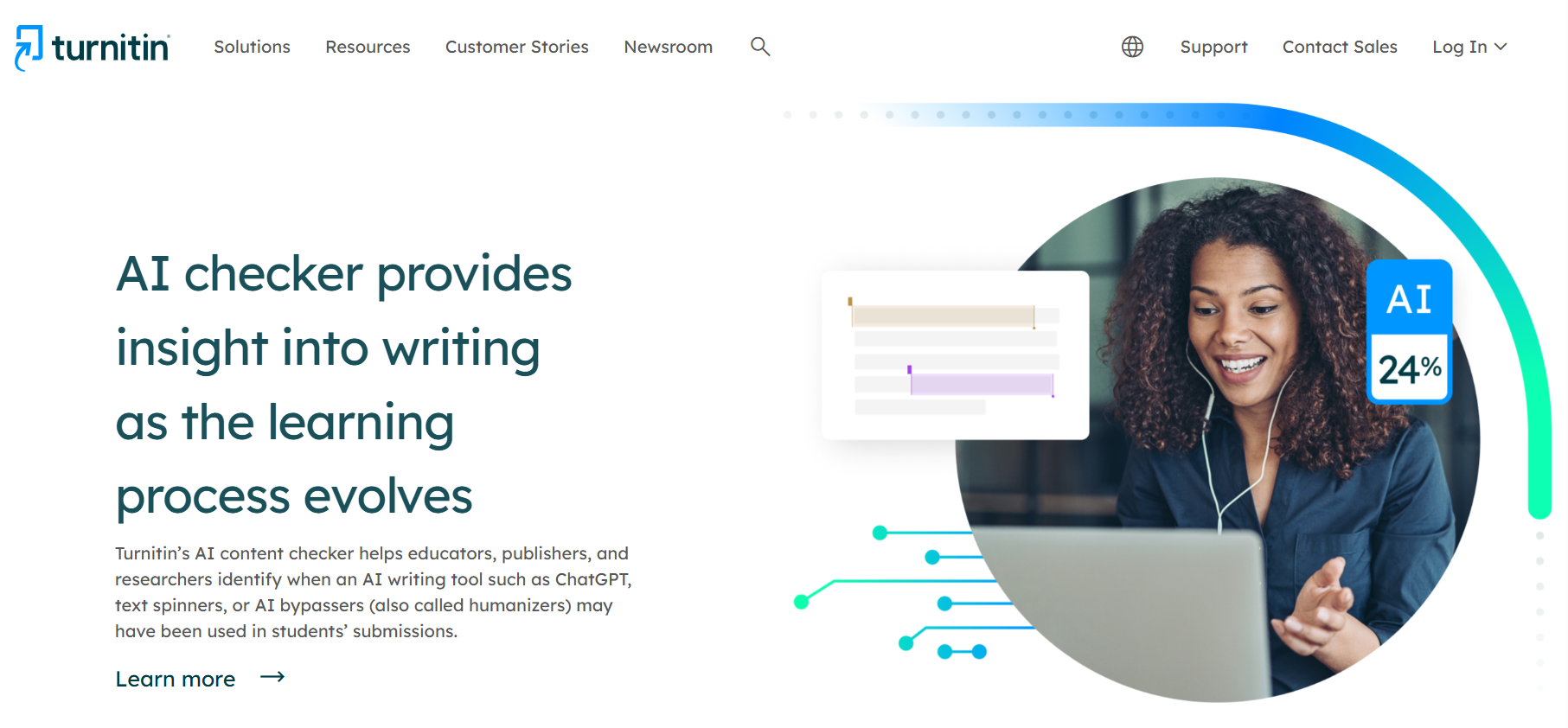
Turnitin’s separate Similarity Report compares work with web pages, earlier student papers, journals, and publications. QuillBot places its detector and writing tools in one personal account, but reserves plagiarism scans for Premium.
Where each tool fits best
QuillBot fits the drafting stage. A student controls the scan. The results can expose copied wording, citation gaps, and sentences with an AI-like score.
Turnitin fits a school review. Students may see a Similarity Report if settings allow. The AI report stays instructor-facing unless it is shared.
Is Turnitin AI detector accurate enough to support a decision on its own? No. Turnitin says the result should never be the only basis for action.
Key differences in detection coverage
Turnitin publishes broader academic matching coverage, while QuillBot offers easier access. QuillBot also states that its Plagiarism Checker cannot detect paraphrased content, though copied phrases may remain.
A Turnitin review can surface close wording and separate AI signals. Neither report proves that a specific paraphraser produced the text.
What each platform is designed to flag
| Check | QuillBot | Turnitin | Practical meaning |
|---|---|---|---|
| Direct or close source matches | Premium Plagiarism Checker | Similarity Report | Both can highlight matching text, but database coverage differs |
| Current and archived web content | QuillBot describes a large source database | Billions of web pages | Turnitin publishes more detail about this part of its database |
| Prior student submissions | No comparable student-paper repository is advertised | Checks enabled student and institutional repositories | Turnitin is stronger for cross-submission matching |
| Journals and publications | Source links may appear in plagiarism reports | Includes thousands of periodicals, journals, and publications | Turnitin is designed around academic review |
| Paraphrased source material | QuillBot says its plagiarism checker cannot detect paraphrased content | Some similarity may remain if wording still overlaps | A low similarity score does not certify original ideas |
| AI-generated or AI-altered prose | AI score and sentence-level feedback | Separate AI Writing Report | Both provide model estimates rather than authorship proof |
Is the QuillBot AI checker accurate?
QuillBot can provide a useful warning, but not a final verdict. It advertises a 99% detection rate linked to the RAID benchmark. One figure cannot cover every model, writing style, text length, and editing method.
According to QuillBot, 300-plus words produce more reliable results. Paraphrased AI text is harder to detect. Formulaic human prose may also score high.
The Turnitin AI detection tool has limits as well. Its claimed false-positive rate below 1% applies only to documents with more than 20% likely AI writing. It does not measure every false negative.
A peer-reviewed test of 14 systems also found that editing and obfuscation reduced detection performance. Models have improved since then, but altered text remains difficult.
Results patterns seen in AI detection tests
Raw ChatGPT output is often easier to flag. It may contain steady rhythms, predictable transitions, and repeated phrasing. Editing can break those patterns. AI paraphrasing can create new ones.
In a Quillbot AI detector vs Turnitin comparison, one passage may receive different results. The tools use different models, thresholds, and text rules. A low score still cannot excuse copied ideas or AI use that breaks course policy.
Can Turnitin detect QuillBot?
Turnitin can flag some AI-generated text later modified with QuillBot. It cannot prove which tool was used. Its current guide names QuillBot as an AI-paraphraser example. The English model looks for likely AI-generated and AI-altered prose.
Turnitin estimates patterns. It does not read browser history. On July 20, it announced a future single-color report. The company said separate AI and AI-paraphrased highlights could imply too much certainty.
The Similarity Report offers another route. It may find wording left close to a source after light paraphrasing. That source could be a web page, publication, or student paper.
What Turnitin checks in academic submissions
The Similarity Report measures matching text; the AI Writing Report estimates likely AI-generated or altered prose. An eligible AI report needs 300 to 30,000 words of long-form prose.
English, Spanish, and Japanese are supported, but paraphrasing detection is limited to English. The report is instructor-facing. Students can pre-check similarity only through Draft Coach or an assignment configured for drafts and report access.
Accuracy limits in Turnitin reviews
Turnitin replaces scores from 1% to 19% with an asterisk because false positives are more common there. False negatives remain possible as well.
Short text, lists, code, poetry, and scripts fall outside its reliable long-form use case. A 0% result means no qualifying AI-like text was identified, not that human authorship was verified. Instructors must review the passages, prior work, and policy context.
Common limits of AI and plagiarism detectors
An AI detector studies patterns; a plagiarism checker compares text with known sources. Neither sees the full writing process.
Editing may remove AI signals, and short samples offer too little evidence. QuillBot asks for 80 words and recommends 300 or more; Turnitin requires 300 words of prose. Plagiarism scores also mislead: correct quotations can match, while thoroughly reworded but uncited ideas may not.
Non-native speaker writing
Some detectors may confuse limited word variation with AI predictability. A 2023 study tested seven tools on 91 TOEFL essays. On average, more than half were wrongly flagged. Turnitin was not tested.
A later ACL study examined 16 systems. Several models misclassified English learners more often, though others did not.
Turnitin’s own test reported 1.4% false positives for English learners and 1.3% for native writers. That company-run result needs context from independent research and the student’s known work.
Best use cases for each tool
QuillBot works best as a pre-submission editing prompt. Its results can expose generic passages, copied wording, and missing citations.
Turnitin belongs inside an academic review process. Its reports gain meaning from assignment rules, writing history, and conversation with the student. Neither tool should be used to chase a “safe” percentage. The goal is work that follows the stated policy and credits borrowed ideas.
Citation and originality review
Citation review should begin with the sources. Check every quotation for quotation marks and a reference. Then review paraphrased ideas to make sure the source is still credited.
QuillBot’s Premium plagiarism report can help locate matching passages and create APA, MLA, or Chicago citations.
Turnitin’s Similarity Report offers deeper source matching, but it cannot decide whether each match is acceptable. A bibliography, a common phrase, or a correctly quoted passage may raise the percentage without showing plagiarism.
Critical considerations for students and writers
The course policy matters more than the detector score. Some instructors permit AI for brainstorming or grammar support. Others require disclosure, limit it to named tasks, or ban generative AI help entirely.
Using QuillBot to reword unauthorized AI text does not make the process compliant. It may change the surface language. The ideas and drafting process may still breach the rules. Rewording can also add vague phrases, bad synonyms, or small changes in meaning.
Keep your research notes, outline, source list, and draft history. These records make revision easier and can show how the work developed if a result is questioned.
Flagged submission consequences
A flag may lead to a conversation or a request for drafts. A student may have to explain the work aloud. A formal integrity review is also possible. The response depends on school policy and the other evidence.
One detector score should not be treated as a confession. At the same time, students should not assume every institution will handle uncertain results well. Saving version history and understanding the appeal process can matter when software gets the first word.
Comparison criteria and decision factors
Choose the tool based on your task, not the percentage you hope to receive. QuillBot answers, “What should I inspect in this draft?” Turnitin helps a school ask, “What evidence here needs human review?”
Decision matrix for common checking needs
| Your situation | Better starting point | What to inspect next | Red flag |
|---|---|---|---|
| You want a fast AI check on your own draft | QuillBot AI Detector | Read every highlighted sentence in context | Rewriting only to lower the score |
| You need to find copied wording before submission | QuillBot Plagiarism Checker | Open the matched sources and fix citations | Assuming no match means no plagiarism |
| You are reviewing submitted academic work | Turnitin | Compare Similarity and AI reports with prior writing | Treating either percentage as automatic proof |
| You paraphrased a source | Manual citation review, then a checker | Confirm that the idea is credited | Believing new wording removes the need to cite |
| You are accused of unauthorized AI use | Draft history and institutional process | Gather notes, versions, and source records | Relying on a second detector as the whole defense |
Final assessment: which tool should you trust?
Trust each tool only for the job it can perform. Turnitin is more capable for a formal school review. It checks a broad source database and stored student papers. Its reports also fit an instructor-led process. That does not make every flag correct.
QuillBot is the more practical choice for individual pre-checks. It is easy to open, and it offers a usable free AI scan. Its paid plan adds plagiarism and citation tools. The price is public, unlike Turnitin’s custom school quotes.
The final verdict is use-case-based. Choose QuillBot to inspect your own draft. Expect Turnitin when a school reviews a submission. Trust neither platform to settle authorship without context.
QuillBot for accessible pre-checks
QuillBot works best when the score sends you back to the writing itself. Review a flagged passage. Is it generic, too smooth, unsupported, or unlike your usual voice? Revise it from your notes and sources.
Do not keep paraphrasing the same sentence until a detector changes its verdict. That turns writing into a process where you only seek AI’s approval. The better check is simple. Can you explain the idea and defend the wording? Can you show where the information came from?
Frequently asked questions
What is the difference between QuillBot’s plagiarism checker and its AI detector?
QuillBot’s plagiarism checker finds text that resembles material in its source database. The AI Detector looks for AI-like patterns. A passage can be original yet AI-generated, or human-written yet copied. The plagiarism feature requires Premium and includes 25,000 words per month. The AI Detector has limited free access and does not search for sources.
Can paraphrased AI text still be flagged by Turnitin?
Yes, paraphrased AI text can still be flagged by Turnitin, especially in long-form English prose. Its model looks for likely AI text changed by a paraphraser or bypasser. Can Turnitin detect QuillBot? It may detect the resulting AI-paraphrased signals, but it cannot prove that QuillBot or any other AI tool was used.
Does QuillBot check against academic databases like Turnitin?
No, QuillBot does not advertise a student-paper repository like Turnitin’s. Its paid checker returns matched links, scores, and citation help. Turnitin lists archived web pages, prior student papers, journals, and other publications among its sources.
Is Turnitin available to individual students, or only through schools?
Turnitin is sold to schools and other organizations, not individual students. Access usually comes through an assignment, a school learning platform, or Draft Coach. Turnitin suggests iThenticate for personal professional checks. That is a separate product, not a personal Turnitin plan.
Should students use QuillBot before submitting academic work?
Students can use QuillBot for allowed draft checks, citations, grammar help, or plagiarism screening. Yet, they should read the assignment’s AI rules first. Is QuillBot reliable? Its tools can highlight passages worth reviewing and possible citation issues. Still, no score can promise that Turnitin will agree or that the work follows course policy.
Which tool is better for checking originality before submission?
QuillBot is easier for a personal pre-check. Turnitin offers stronger source matching when a school provides access. “Originality” also covers the writing process. Check the sources, citations, notes, and AI rules yourself. No percentage covers all of them.
Key takeaways
- QuillBot says its AI results are more dependable with samples longer than 300 words. Very short passages can produce unstable scores.
- Turnitin displays AI results between 1% and 19% as an asterisk because this range carries a greater risk of false positives.
- Neither detector can prove that a writer used QuillBot, ChatGPT, or another AI tool. The results show patterns, not authorship.
- Edited AI text, formulaic academic prose, and heavily paraphrased passages remain difficult for detectors to classify consistently.
- Detector output should begin a careful review, not end one. Writing history, source notes, course rules, and the writer’s explanation provide stronger context than a percentage alone.
QuillBot and Turnitin are not interchangeable. QuillBot gives writers a direct way to inspect drafts and likely AI patterns. Its paid plan adds plagiarism checks. Turnitin serves schools that need source matching and instructor-side AI review.
The best Quillbot vs Turnitin choice depends on who is checking the text and why. Use QuillBot for occasional tweaks before submission. Use Turnitin as one source of evidence during formal review.
The strongest protection is not a low score. It is work you can explain. You should also be able to trace your sources and show a process that follows the rules.